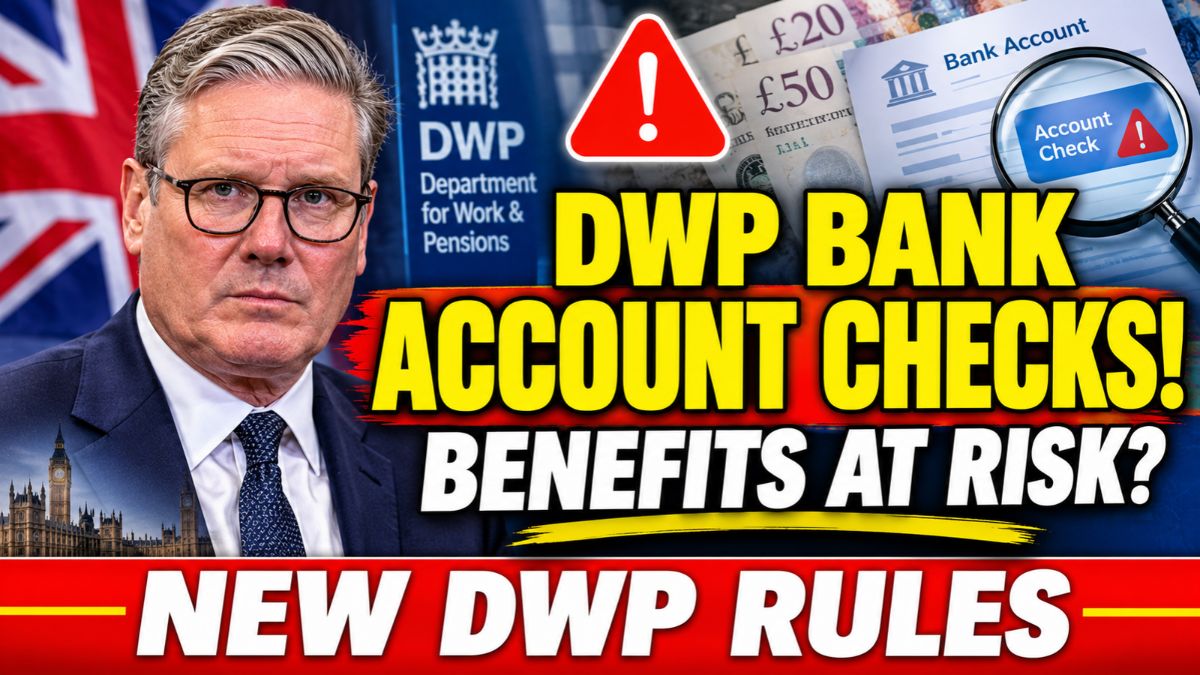
The UK Department for Work and Pensions (DWP) has started a new system of bank account checks designed to identify incorrect benefit payments and reduce welfare fraud. The initiative gives the department new powers to require banks and other financial institutions to identify accounts that may indicate a claimant no longer meets certain benefit eligibility conditions.
The government expects the measures to generate £1.2 billion in savings by the 2030/31 financial year. The checks will initially cover Universal Credit, Pension Credit and Employment and Support Allowance (ESA).
Under the new rules, banks can be required to share limited financial information, including account balances, account holder details and dates of certain overseas transactions. However, they cannot provide complete bank statements or detailed spending histories under these verification notices.
The changes have also raised concerns among privacy organisations, which question whether wider financial checks could expose eligible claimants to unnecessary investigations. The government says additional safeguards will ensure that a flagged account does not automatically result in benefits being reduced or stopped.
Checks
The new system operates under the Eligibility Verification Measure (EVM), introduced through the Public Authorities (Fraud, Error and Recovery) Act 2025.
The DWP has issued its first Eligibility Verification Notice (EVN), marking the beginning of a controlled testing phase. These notices require participating financial institutions to identify accounts that match specific eligibility indicators supplied by the department.
The indicators relate to existing benefit conditions rather than general consumer spending.
For example, some means-tested benefits have restrictions on savings and capital. If a claimant’s financial circumstances change, they may no longer qualify for the same level of support.
The DWP can use the new powers to identify accounts that may indicate:
- Savings above the applicable benefit eligibility threshold.
- Financial arrangements involving linked or joint accounts.
- Transactions suggesting that a claimant has spent an extended period outside the UK.
- Other potential inconsistencies with benefit eligibility requirements.
The measures initially apply to three benefits:
- Universal Credit.
- Pension Credit.
- Employment and Support Allowance.
The department has stated that the purpose is to identify possible payment errors earlier and reduce the amount of money that may need to be recovered later.
Eligibility
Universal Credit claimants are among those who may be affected by the new verification arrangements.
Generally, people with more than £16,000 in countable capital are not eligible for Universal Credit. Those with savings between £6,000 and £16,000 may receive reduced payments because of the assumed income calculation applied to their capital.
The DWP may therefore ask banks to identify accounts with balances that could indicate a potential eligibility issue.
Time spent outside the UK is another consideration. Universal Credit claimants are generally permitted to remain abroad for up to one month, although certain exceptions apply.
Pension Credit and Employment and Support Allowance also have their own eligibility conditions, including rules relating to income, capital, residence and circumstances.
Importantly, having savings or spending time overseas does not automatically establish benefit fraud. The department must consider the relevant rules and individual circumstances before making an entitlement decision.
The official GOV.UK Universal Credit guidance explains the main eligibility requirements, including the capital rules that may affect claimants.
Information
The new legislation places restrictions on the financial information banks can provide to the DWP.
When an account matches an eligibility indicator, financial institutions may be required to share specific information, including:
| Information category | What may be shared |
|---|---|
| Account holders | Names of account holders |
| Account details | Account numbers and sort codes |
| Linked accounts | Details of relevant linked and joint accounts |
| Financial information | Relevant account balances |
| Overseas activity | Dates of qualifying overseas transactions |
The department cannot use these notices to obtain complete bank statements or detailed records of everyday purchases.
Banks are also not required to provide information about specific shopping transactions, detailed spending histories or the precise locations where purchases were made.
The measure does not give the DWP direct access to online banking accounts or allow officials to monitor financial activity continuously.
There are also restrictions on sensitive personal information, including details concerning political opinions and religious beliefs. Financial institutions must follow the statutory requirements when responding to verification notices.
Information about people who are not relevant to a benefits investigation must be handled in accordance with the applicable data protection and information management requirements.
Investigations
Receiving an Eligibility Verification Notice does not mean a claimant has been found guilty of fraud or has automatically lost entitlement to benefits.
The information supplied by a bank is intended to help the DWP identify accounts that may require further examination. Officials must conduct additional enquiries before deciding whether a claimant has received payments incorrectly.
If the investigation identifies an overpayment, the department may take action to recover the money. Depending on the circumstances, this could involve reducing future payments, changing entitlement or terminating benefits.
However, claimants may have legitimate explanations for financial information identified through the checks.
For example, certain personal injury compensation payments, money held in trust for another person and qualifying proceeds from selling a property may receive different treatment under benefit rules.
Similarly, some people can remain outside the UK for longer than the standard permitted period because of specific circumstances, such as medical treatment or bereavement.
Claimants should be prepared to provide relevant documents if the DWP requests clarification about their financial circumstances.
The government has also outlined safeguards requiring the department to assess information properly rather than treating a bank notification as proof of wrongdoing.
Savings
The DWP estimates that the new verification arrangements could save approximately £1.2 billion by 2030/31.
These projected savings are expected to come from identifying undeclared capital, incorrect benefit claims and other circumstances that could lead to overpayments.
The initiative forms part of wider government efforts to improve the accuracy of welfare payments and manage public spending.
The department argues that identifying eligibility problems earlier could also benefit claimants by preventing debts from building up when payments continue after someone becomes ineligible.
Further information about benefit administration and the department’s responsibilities is available through the official Department for Work and Pensions website.
However, the projected savings remain a government estimate. The actual financial impact will depend on how effectively the system identifies incorrect payments and how much of the flagged information leads to confirmed eligibility changes.
Privacy
The expansion of financial verification powers has attracted criticism from civil liberties and disability organisations.
Big Brother Watch has described the system as a form of financial surveillance, arguing that requiring banks to screen accounts associated with benefit recipients could affect people who have not been suspected of fraud.
Disability Rights UK has also raised concerns about investigations that could begin without individual evidence of wrongdoing.
One important concern is the possibility of incorrect information being interpreted as a benefit eligibility problem. For example, money held in a joint account or funds received for a specific purpose may not necessarily represent savings available to the claimant.
The government says the new safeguards are intended to prevent such misunderstandings from automatically affecting payments.
An independent reviewer will examine how the powers are being used, including compliance by the DWP and participating financial institutions. Reports on the operation of the system will also be presented to Parliament.
The effectiveness of these safeguards will be important in determining whether the new arrangements can reduce payment errors without creating unnecessary investigations for eligible households.
Previous
The latest verification system follows an earlier DWP project involving open banking technology.
In 2025, the department explored a procurement process intended to support the verification of Universal Credit claims through financial information shared with the claimant’s consent.
The proposed approach would have allowed individuals to share information such as account balances and transaction records through open banking services.
However, the department abandoned that procurement project in June 2026, citing changing delivery priorities.
The earlier proposal relied on voluntary consent, meaning it could not necessarily be applied to every Universal Credit claim.
The new Eligibility Verification Measure follows a different approach. Rather than relying on individual consent for each information-sharing exercise, it allows the DWP to issue statutory notices to financial institutions.
This represents a significant change in how the department can verify certain financial circumstances.



Outlook
The DWP’s bank account checks are expected to develop gradually, beginning with a controlled testing phase. The department will need to demonstrate that the system can identify genuine eligibility problems while respecting the restrictions placed on financial information.
For claimants, the main practical consideration is to keep benefit information accurate and report changes in savings, income and personal circumstances when required.
People who hold joint accounts, receive compensation or spend extended periods abroad should understand how these circumstances are treated under their specific benefit rules.
The new system does not mean that every person receiving Universal Credit, Pension Credit or Employment and Support Allowance will automatically face a detailed investigation. It is intended to identify accounts that match particular eligibility indicators and refer potential concerns for further assessment.
Ultimately, the £1.2 billion savings target will depend on the accuracy of the checks, the effectiveness of independent oversight and the department’s ability to distinguish genuine payment errors from legitimate financial circumstances.