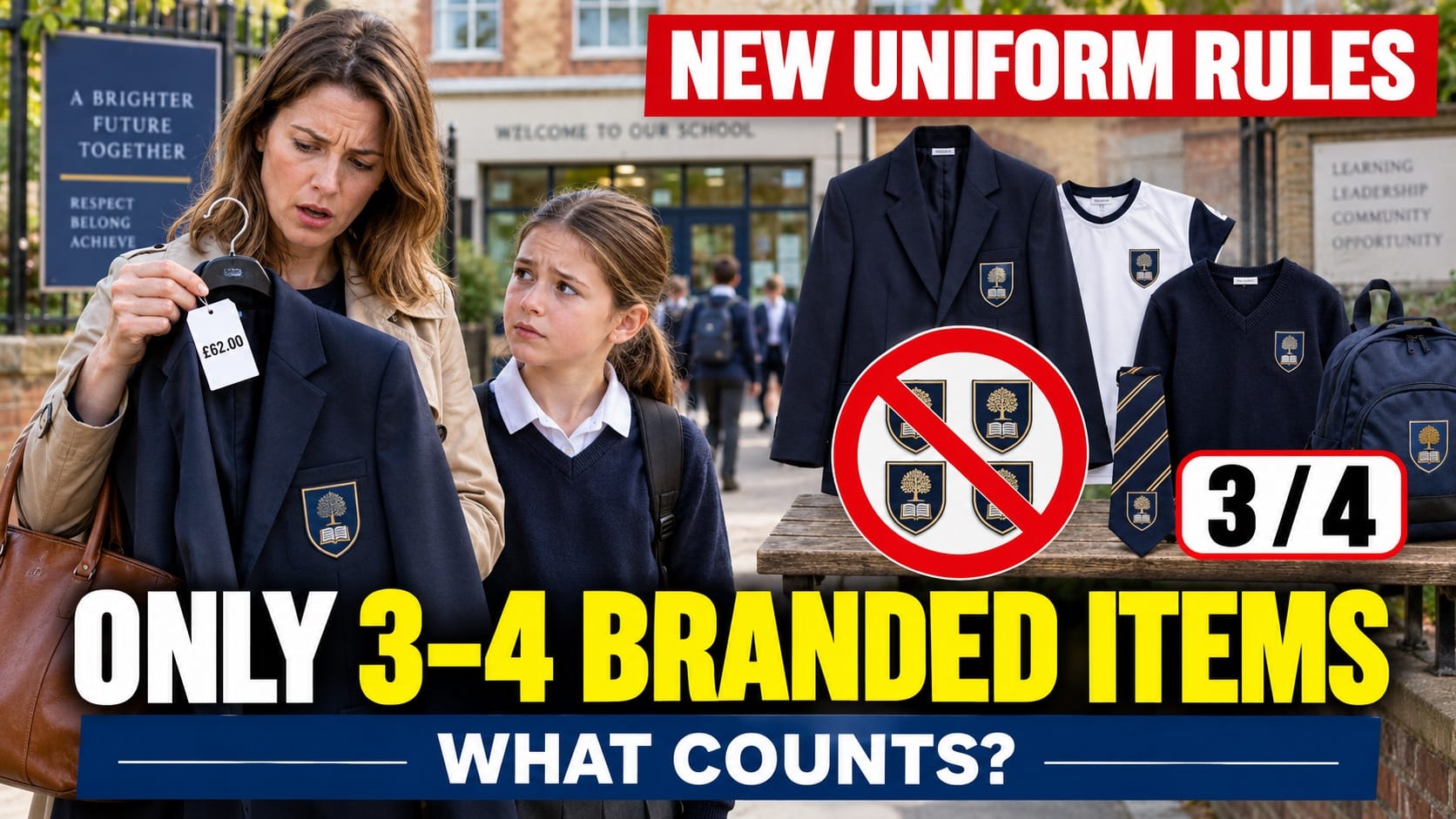
New school Uniform rules are now in force in England, limiting how many compulsory branded items schools can require families to buy. The change is designed to stop schools and suppliers pushing parents towards expensive logoed clothing, sports kits and single-supplier ranges.
The Department for Education announced the changes on 4 September 2026, as many families were preparing for the new school year. The rules matter because an item cannot avoid the limit simply because a school labels it “optional” while offering no realistic, affordable alternative.
How many branded items can schools require?
From September 2026, primary schools must limit compulsory branded uniform and PE items to three or fewer. Secondary and middle schools can require up to four, but only if one of those items is a tie.
The limit covers items pupils must have or wear for school, travelling to and from school, lessons, clubs or school activities. It can include branded bags and seasonal clothing. A school cannot require five different branded items by counting summer and winter clothing separately.
The Department for Education’s statutory guidance explains the legal limits and how schools should apply them.
What counts as a branded item?
A branded item is more than a garment with a stitched logo. The guidance also covers clothing with a distinctive colour, design, fabric or trim that can only be bought from the school’s appointed supplier.
By contrast, a plain grey cardigan or navy skirt available from several retailers would normally be a generic item. Schools can still set reasonable rules about colour, shade, fabric, fit and appearance, but those requirements should not force parents to use one expensive supplier.
If pupils can choose between two branded options, such as a branded skirt or trousers, that choice counts as one item because only one is required. The total number of compulsory items across the school year is what matters.
Can schools call branded clothing optional?
Schools may offer optional branded items, but they should keep them to a minimum and allow a generic alternative. Calling an item optional does not solve the problem if parents are pressured to buy it or if there is no affordable way for a child to meet the school’s requirements without it.
The government’s announcement on school-uniform costs specifically warns against schools hiding expensive requirements behind the word “optional”. The same principle applies to branded sports kit: parents should not be pushed into buying costly clothing for ordinary school activities.
What should schools do about suppliers?
Schools and governing boards must give proper weight to affordability and value for money. They should avoid single-supplier contracts except where there is a clear reason, review supplier arrangements regularly and consider suppliers that offer payment plans.
The guidance also expects schools to make second-hand uniform easily available to all parents, including families whose children are about to join the school. Details should be clear and published on the school website.
For higher-cost items such as blazers and jumpers, schools should examine whether branding, specialist tailoring or unusual fabric and trim add avoidable expense. Sew-on badges can sometimes allow families to buy a suitable garment from a wider range of shops.
What parents should check
Parents can check the school’s published uniform policy before buying anything. It should clearly separate compulsory items from optional ones and identify where generic alternatives are allowed.
Before placing an order, check:
- the number of compulsory branded uniform and PE items
- whether a tie is included in the secondary-school total
- which items can be bought from ordinary retailers
- whether branded bags, summer clothing or sportswear have been counted
- how to obtain second-hand items or financial support
- whether the school offers a payment plan or more than one supplier
Keep the uniform list and receipts. If the school’s website does not explain the requirements clearly, ask the school or governing board to confirm which items are compulsory.
What if a school does not follow the rules?
The statutory guidance applies to schools in England, including maintained schools and academies. Schools and governing boards must have regard to it when setting their uniform policies.
Parents should raise concerns with the school first and explain the specific cost or requirement that appears inconsistent with the published policy. The guidance says schools should engage with parents and pupils and publish an understandable policy online.
If a school continues to require too many branded items or refuses to recognise an affordable generic alternative, parents can follow the school’s complaints procedure and contact the relevant governing body or academy trust. The Education Secretary can take action where a school’s uniform policy does not follow the rules.



Why the change matters
Uniform is meant to create a shared identity, but high costs can make it harder for children to attend, take part in PE or join activities. The updated rules give families more choice over where they shop and make it harder for schools to shift unnecessary costs onto parents.
The practical test is simple: count every branded item a pupil is required to have during the school year, check whether a reasonably priced generic alternative exists and read the school’s published policy before spending money. The rules apply in England; Scotland, Wales and Northern Ireland have separate education arrangements.