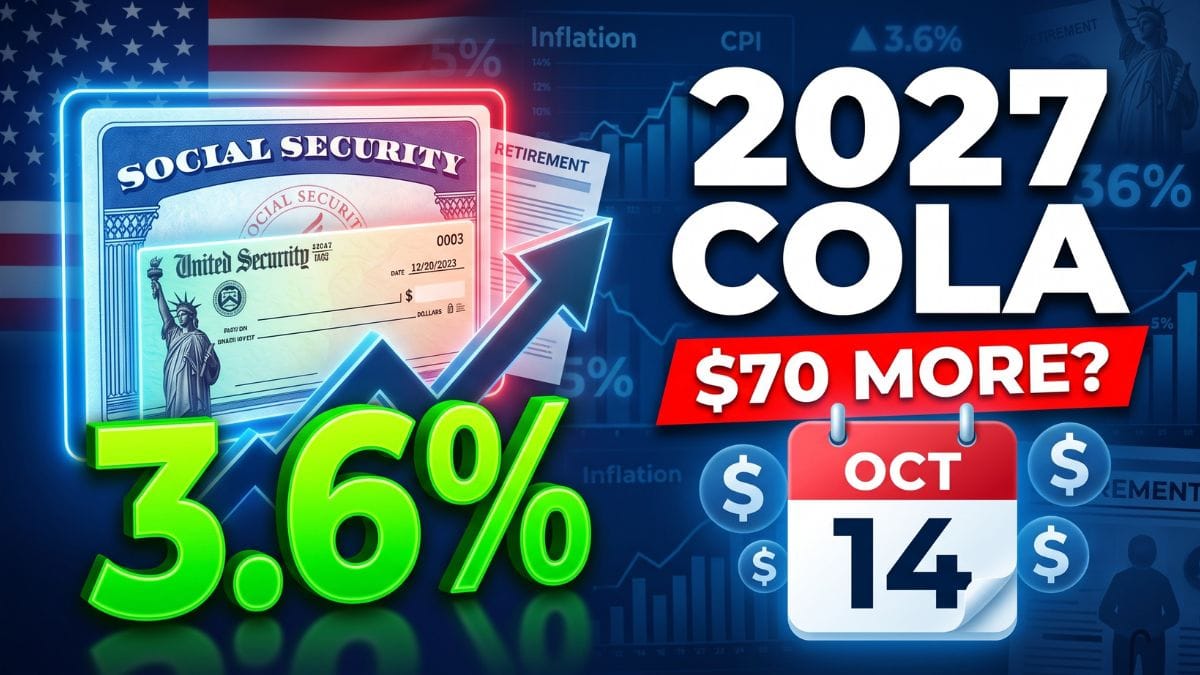
Social Security recipients could see a larger cost-of-living adjustment in 2027, with the latest projection from the Senior Citizens League putting the increase at 3.6%. If the estimate holds, it would be the biggest annual COLA since the 8.7% increase approved for 2023.
The projection is not yet the official figure. Social Security’s 2027 COLA will depend on inflation readings through September 2026, with the Social Security Administration expected to announce the final adjustment in October. For retirees planning household budgets, even a small change in the percentage can translate into a noticeable difference in monthly income.
Projection
The Senior Citizens League currently estimates a 3.6% COLA for 2027 based on inflation data available so far.
If that percentage becomes the final adjustment, the average Social Security retirement benefit would increase by roughly $70 per month, according to the projection. That would put the typical monthly benefit at around $2,007 under the assumptions used for the estimate.
The actual increase for an individual recipient will depend on their current benefit amount. A person receiving more than the average would generally see a larger dollar increase, while someone receiving less would see a smaller one.
Formula
Social Security’s annual COLA is tied to inflation rather than being chosen arbitrarily by the government.
The calculation uses the Consumer Price Index for Urban Wage Earners and Clerical Workers, commonly known as CPI-W. The Social Security Administration compares the average CPI-W readings for July, August and September with the corresponding figures from the previous year.
Because September’s inflation data is part of the calculation, the 2027 COLA cannot be finalized until the third-quarter data is available.
That is why current projections can still change. If inflation rises or falls more than expected during the remaining months of the calculation period, the eventual COLA could differ from the current 3.6% estimate.
History
The projected 2027 increase would be higher than the COLAs seen in the two previous years.
| Year | Social Security COLA |
|---|---|
| 2023 | 8.7% |
| 2024 | 3.2% |
| 2025 | 2.5% |
| 2026 | 2.8% |
| 2027 | 3.6% projected |
The 2023 increase was unusually large because of elevated inflation following the pandemic. Since then, the annual adjustments have returned to more moderate levels.
A 3.6% increase would therefore represent a noticeable rise compared with the 2.5% adjustment in 2025 and the 2.8% increase in 2026.
Impact
For retirees, the percentage itself only tells part of the story. The more practical question is how much additional money will arrive each month.
For example, a 3.6% increase on a $2,000 monthly benefit would add about $72 per month. Over a full year, that would amount to roughly $864 before considering any changes in deductions or other expenses.
The effect can be different from household to household. Housing, healthcare, food and utility costs make up different portions of retirees’ budgets, so an overall inflation measure may not perfectly reflect the expenses facing every beneficiary.
The Senior Citizens League has argued that this distinction is important because older households can experience inflation differently from the broader population.
Purchasing
The debate over whether Social Security COLAs adequately protect purchasing power has continued for years.
According to the Senior Citizens League, Social Security benefits have lost an estimated 13.7% of their buying power since 2016 when measured against inflation experienced by older Americans. Over the same period, official COLAs have increased benefits by a cumulative 32.3%.
These figures illustrate why a higher COLA does not necessarily mean retirees will feel significantly wealthier. COLAs are designed to offset inflation, not necessarily to increase a beneficiary’s purchasing power.
If prices for necessities rise faster than Social Security benefits, retirees can still experience pressure on their household budgets even after receiving an annual adjustment.
Changes
The 2027 COLA will be only one of several changes affecting Social Security recipients and workers next year.
Other annual adjustments can include changes to earnings limits, taxable earnings and other program figures. These updates can affect people who are still working while receiving Social Security as well as workers who are paying into the program.
For beneficiaries, the final COLA will be particularly important because it determines the starting point for monthly benefits throughout 2027.
However, a higher benefit does not necessarily mean an equivalent increase in disposable income. Medicare premiums, taxes and other deductions can affect the amount that ultimately reaches a retiree’s bank account.



Outlook
Current estimates from different analysts have placed the potential 2027 COLA in a range of roughly 3.4% to 3.8%, although those projections can move as new inflation data becomes available.
Earlier forecasts were sometimes higher, including estimates of 3.8% or more, but projections have moderated as inflation readings changed.
The 3.6% estimate should therefore be viewed as a forecast rather than a guaranteed increase. The final number will be determined using the official CPI-W data required under Social Security’s COLA formula.
For retirees, the key date is October 14, 2026, when the Social Security Administration is scheduled to announce the official 2027 COLA. Until then, the 3.6% figure provides an indication of what beneficiaries could receive, but the final adjustment could still be higher or lower.
If the projection holds, the 2027 increase would give Social Security recipients a larger adjustment than they received in 2025 or 2026 and would mark the biggest COLA since 2023. The size of the increase will ultimately depend on inflation, while its real impact will depend on how quickly retirees’ everyday expenses rise.