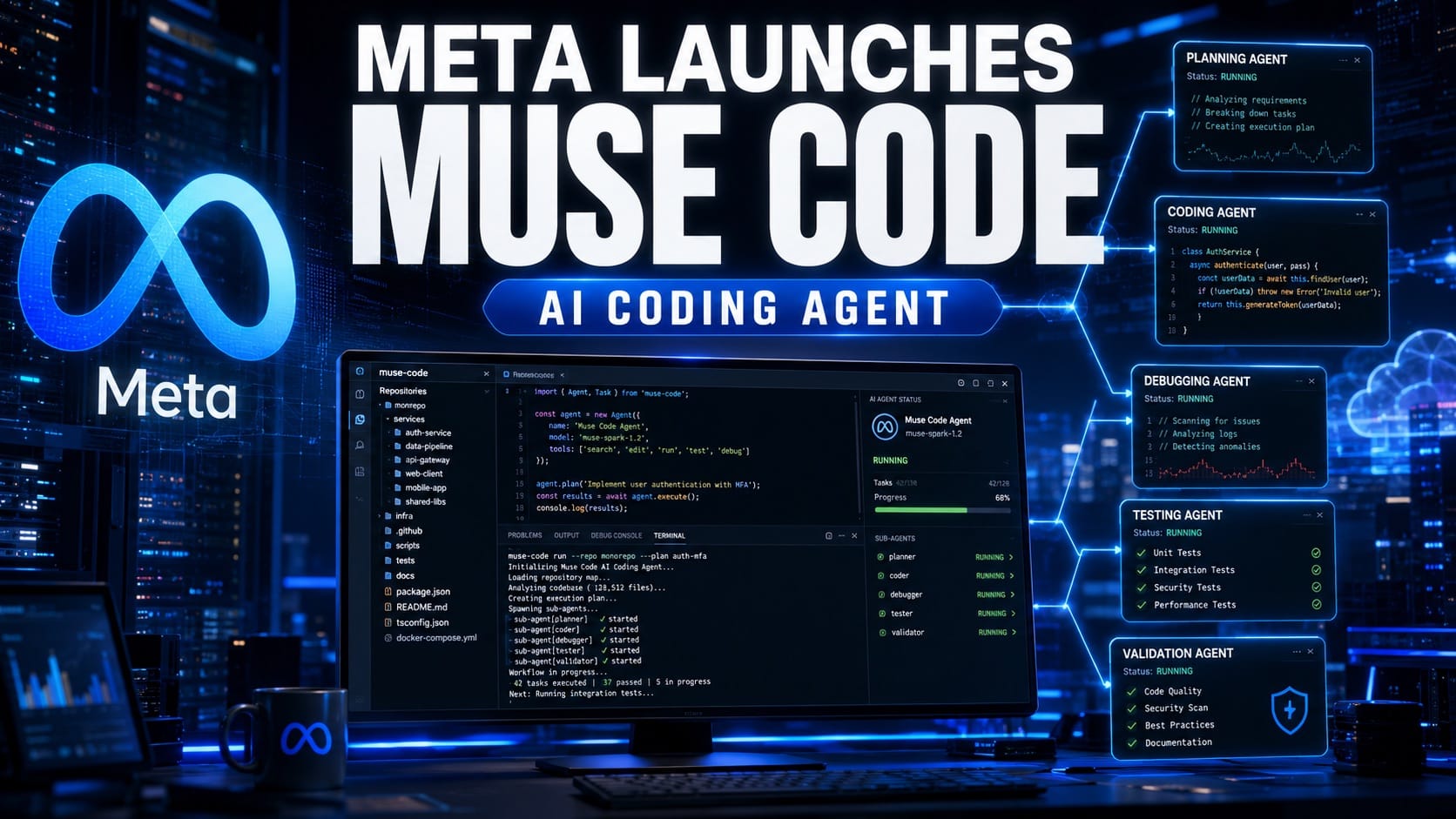
Meta is expanding its push into AI-powered software development with Muse Code, a terminal-based coding agent designed to take on complex engineering work across large codebases. The beta release gives Meta a direct entry into a fast-growing market where AI systems are moving beyond code suggestions toward planning, testing, and executing multi-step development tasks.
Muse Code is powered by Muse Spark 1.2, a newer model from Meta Superintelligence Labs. Rather than functioning primarily as an autocomplete tool, the agent is built for longer software engineering workflows, including writing and debugging code, coordinating work across repositories, and validating changes.
| Muse Code | Meta’s terminal-based AI coding agent, currently released in beta. |
| Core model | Meta’s Muse Spark 1.2 model powers the coding agent. |
| Primary use | Designed for complex and long-running engineering tasks across large repositories. |
| Agent system | Can use parallel sub-agents to divide larger software development workloads. |
| Market position | Moves Meta deeper into the competitive market for agentic AI developer tools. |
Muse Code Targets Complex Software Engineering

The central idea behind Meta AI’s Muse Code release is that coding agents need to manage more than isolated programming requests. Modern software repositories can contain thousands of files, interconnected services and development rules that make seemingly simple changes difficult to execute safely.
Muse Code addresses that challenge with an agent architecture capable of breaking larger jobs into smaller units. For sufficiently complex work, separate sub-agents can operate simultaneously in isolated worktrees. That structure allows multiple tasks to progress in parallel without having each agent modify the developer’s primary working copy at the same time.
The approach could be particularly relevant for developers using AI on repository-wide changes, feature development, debugging and other projects that require sustained context rather than a single generated code snippet.
Also Read: Elon Musk Rocket Moon Crash Puts SpaceX Strategy in Focus, What U.S. Investors Should Watch Next
Persistent Agents Support Longer Tasks
Meta has also designed Muse Code around persistent background agents. Instead of repeatedly starting new agents and rebuilding context, specialized agents can remain active during a session and continue gathering information or completing assigned work.
A local append-only event log records activity such as model calls, edits and tool operations. This architecture is intended to make the runtime more resilient during long-running jobs because a disrupted task can resume from recorded activity instead of requiring the entire process to restart.
That emphasis on persistence reflects a broader change in AI coding products. The competitive question is increasingly not simply which model writes the best function, but which system can reliably understand a project, plan changes, use tools and keep working toward a larger engineering objective.
Muse Spark 1.2 Powers the Agent
Muse Code’s capabilities are closely tied to Muse Spark 1.2. Meta has positioned its Muse family around reasoning and agentic workloads, making the coding agent an important commercial application for the company’s newer AI models.
The release also arrives as Meta renews its broader emphasis on open-weight artificial intelligence. On August 10, CEO Mark Zuckerberg used an official post on X to highlight Meta’s support for open source alongside the company’s latest AI releases and its longer-term vision for making advanced AI more broadly available.
Meta separately introduced Muse Glimmer, a 30-billion-parameter open-weight model designed to run agentic workloads locally on consumer hardware. Muse Glimmer and Muse Code address different deployment scenarios, but together they illustrate Meta’s effort to build an AI ecosystem spanning developer tools, cloud-accessible models and models capable of running directly on personal devices.
Meta Expands Its AI Developer Strategy
Muse Code places Meta more directly against established AI coding platforms from companies including OpenAI and Anthropic. Coding has become one of the clearest commercial applications for advanced reasoning models because developers can evaluate AI-generated work against concrete outcomes such as successful builds, passing tests and completed engineering tasks.
The launch is also significant for Meta because the company has invested heavily in AI infrastructure and Meta Superintelligence Labs. A developer product provides another route for turning that investment into direct usage outside Meta’s consumer applications and advertising businesses.
Meta has introduced pay-as-you-go access for its Muse model ecosystem, while Muse Code remains in beta. The company’s strategy gives developers another option in a market where pricing, reliability, context management and the ability to complete long-horizon tasks are becoming major competitive factors.



Open AI Strategy Takes Shape
The timing matters beyond coding. Meta is again making open-weight AI a prominent part of its technology strategy as competition intensifies between American AI developers and rapidly advancing Chinese model providers.
Meta’s official newsroom account on X also highlighted the company’s latest AI direction. Meta has said that Muse Glimmer is being released with open weights, while an open-weight version of the more powerful Muse Spark 1.2 is expected to follow.
For U.S. businesses, the broader significance is the growing range of deployment choices. Companies increasingly have to decide whether to rely on hosted proprietary AI, use customizable open-weight models, deploy models locally, or combine those approaches according to security, performance and cost requirements.
Muse Code gives Meta a practical product through which to prove that its latest models can handle demanding real-world work. Its long-term impact will depend on performance outside controlled evaluations, developer trust and whether teams find its multi-agent architecture dependable on production repositories. Even in beta, however, the release makes clear that Meta intends to compete not only in foundational AI models, but also in the developer tools built on top of them.