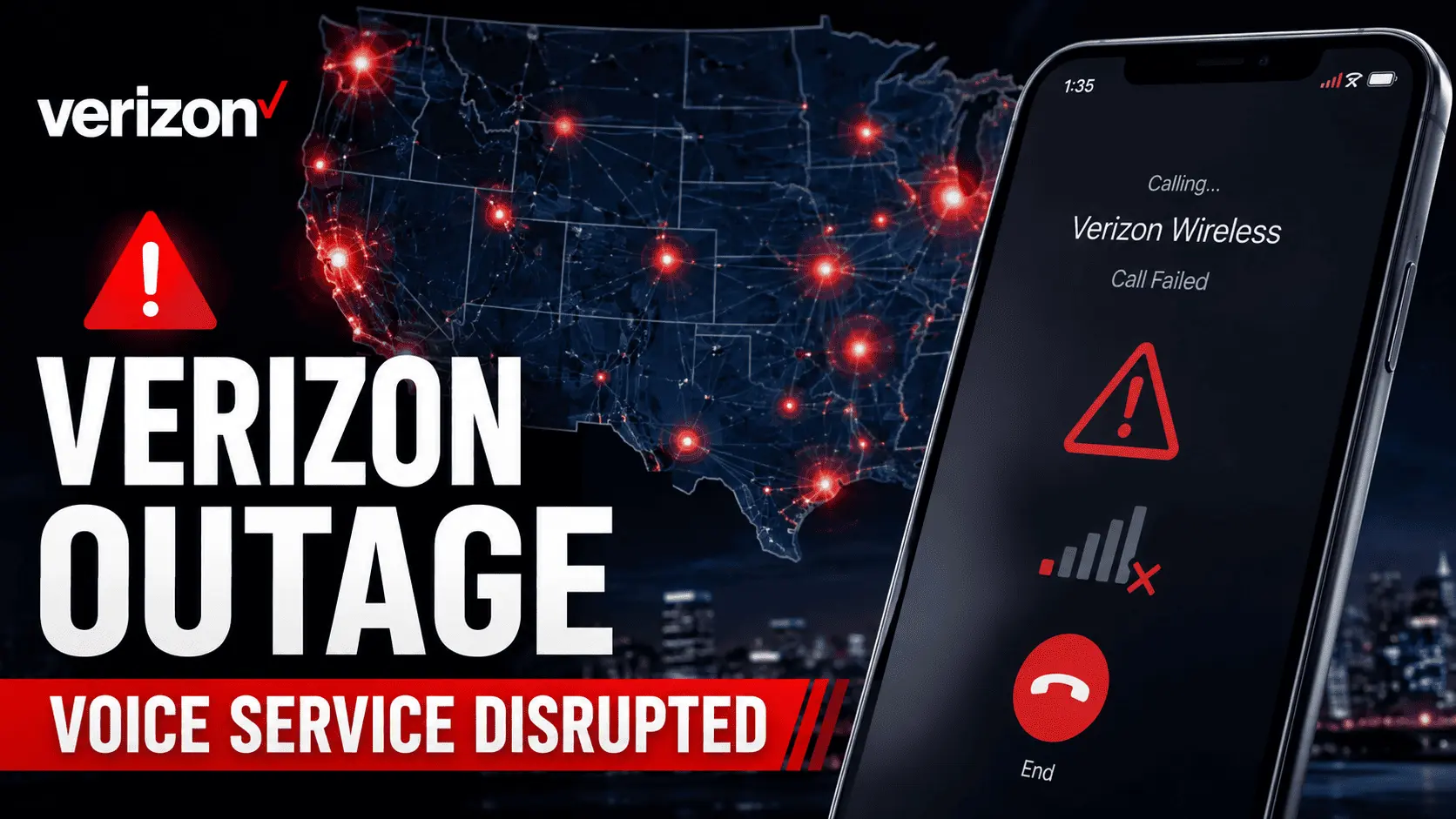
Verizon restored wireless voice service Saturday evening after an outage disrupted calling for customers in parts of the United States, triggering thousands of user reports and renewed attention on the reliability of communications infrastructure. The Verizon outage emerged during the afternoon of August 8, with affected customers reporting problems making or receiving calls.
The disruption was concentrated on voice services rather than being described by Verizon as a complete nationwide network failure. Verizon acknowledged that some wireless customers were affected, deployed engineers to investigate the problem, and later confirmed that the issue had been resolved. For consumers and businesses that depend on mobile connectivity, the incident highlights how even relatively short telecommunications disruptions can have an immediate operational impact.
| Outage date | Verizon reported service problems on August 8, 2026. |
| Affected service | Voice calling was affected for some wireless customers. |
| Customer reports | Downdetector reports exceeded 12,000 during the afternoon. |
| Verizon response | Engineers investigated the issue and worked to restore service. |
| Resolution | Verizon said the voice service issue was resolved Saturday evening. |
Also Read: Elon Musk Rocket Moon Crash Puts SpaceX Strategy in Focus, What U.S. Investors Should Watch Next
Verizon outage affected voice calls across parts of the US
The Verizon outage became increasingly visible Saturday afternoon as customers reported unsuccessful calls and other voice service problems. Downdetector, which collects user-submitted reports about service disruptions, showed more than 12,000 reports by approximately 4:25 p.m. ET, according to published coverage of the incident.
Verizon subsequently confirmed that it was aware of an issue affecting voice services for wireless customers in some areas of the country. The carrier said its engineers were engaged and working to identify and resolve the problem. The company’s description was significant because it indicated a service-specific disruption affecting some customers rather than confirming that its entire nationwide wireless network was offline.
Customer reports climbed during the afternoon
As the disruption continued, customers turned to social media and outage monitoring services to determine whether their individual phone problems were part of a broader Verizon network issue. Reports included customers who said they could not make or receive phone calls.
The geographic reach of individual reports also attracted attention. Customers in multiple areas reported service difficulties, while local reporting in North Carolina documented complaints from wireless users. These reports provided evidence of a multi-region problem, although Verizon characterized the impact as affecting customers in some parts of the United States rather than declaring a nationwide loss of service.
Verizon engineers worked through the service disruption
During the outage, Verizon directed customers toward its network status resources, where users can check network conditions and obtain information about connectivity issues. As engineers made progress, the company advised customers who were still experiencing problems to restart their devices.
After 7 p.m. ET, Verizon said its engineers had resolved the voice service issue. WRAL reported that the company confirmed the problem was resolved around 7:19 p.m. and that its network was operating normally. Verizon also apologized for the inconvenience and continued to recommend restarting devices for customers experiencing lingering service problems.
Why the outage matters for businesses
For companies, a Verizon outage is more than a consumer inconvenience. Mobile networks support sales teams, field employees, authentication systems, customer service operations and time-sensitive communications. A voice service interruption can therefore create productivity problems even when mobile data, Wi-Fi or other communication channels remain available.
The event also illustrates why businesses increasingly treat communications redundancy as part of operational risk management. Organizations with employees who rely heavily on one wireless carrier can face concentrated exposure when that provider experiences a service interruption. Wi-Fi calling, internet-based collaboration platforms and diversified connectivity options can provide alternative communication paths, depending on the nature of an outage.
Also Read: Social Security COLA Could Reach 3.8% in 2027 – What the Latest Forecast Means for Your Check
Network reliability remains a competitive issue
Network performance is a central part of competition among major U.S. wireless carriers. Customers evaluate providers not only on pricing and coverage but also on reliability, customer communication and the speed at which disruptions are resolved. That makes the response to an outage commercially important even when the underlying technical problem is corrected within hours.
Verizon provides businesses with connectivity products spanning wireless and network services through its business operations. For enterprise customers, service reliability can directly influence workflows, revenue-generating activity, and employee productivity, increasing the importance of clear outage communication and resilient network planning.



What Verizon customers should know now
Verizon said the August 8 voice service issue was resolved and its network returned to normal operation. Customers who continued to encounter calling problems after restoration were advised to restart their devices. Persistent problems may require customers to check local network status or contact Verizon support to determine whether the issue is specific to a device, account, or local network condition.
The Verizon outage ultimately proved temporary, but the scale of customer reporting made it a notable U.S. telecommunications disruption. For Verizon, the immediate priority was restoring voice connectivity. For businesses and consumers, the episode is another reminder that mobile service has become critical infrastructure, making network resilience and effective outage response increasingly important to everyday economic activity.