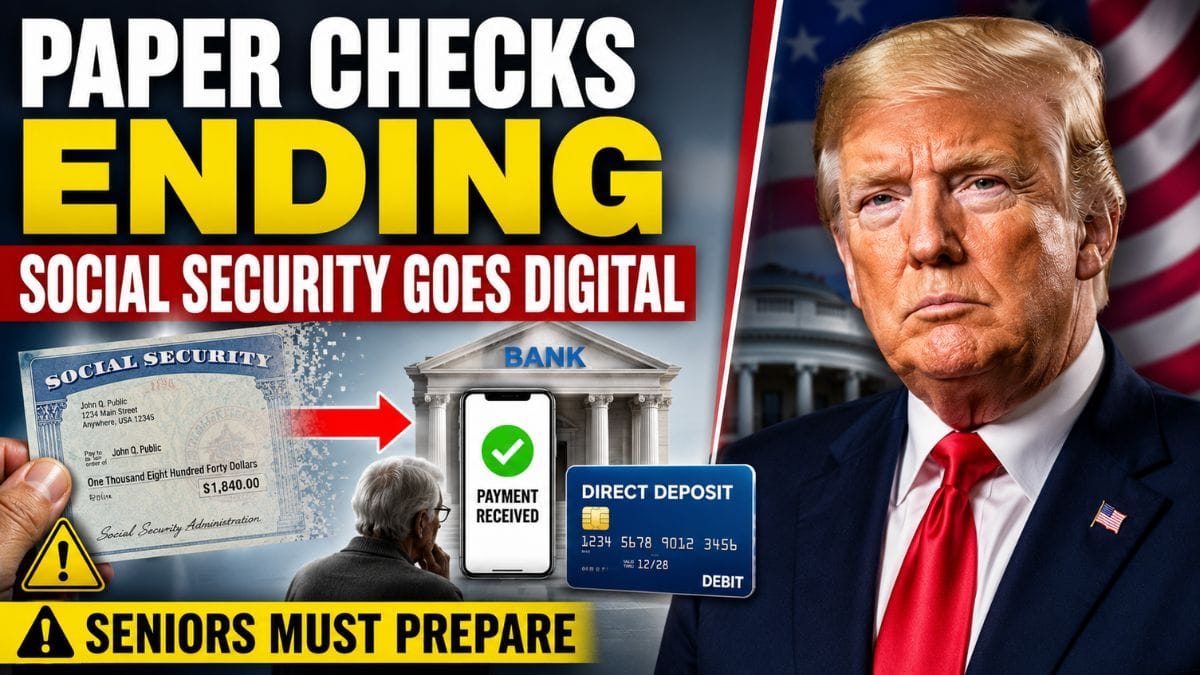
For much of Social Security’s history, monthly benefit checks arriving in the mail were a constant in retirees’ lives. That practice is now nearing its end. In 2025, the Social Security Administration was directed to complete its transition to electronic payments, making paper checks the exception rather than the rule.
Under the new approach, Social Security benefits are paid electronically, either through direct deposit to a bank or credit union account or through a Treasury-approved prepaid debit card. Mailed checks are issued only in limited circumstances and require a government waiver. The SSA says the move is designed to improve payment speed, security, and reliability, and it aligns with a broader federal shift away from paper payments.
For many beneficiaries, the change will be seamless. For others, particularly older adults who still rely on mailed checks, the transition raises practical and financial concerns that families may need to address sooner rather than later.
Context
Social Security payments are a primary source of income for millions of retirees. For some households, they cover nearly all essential expenses, including housing, utilities, food, and medication. Even a brief disruption can create serious hardship.
That reality gives added weight to the move away from paper checks. While often described as a modernization effort, the change also touches on consumer protection, access to banking, and fraud prevention. Beneficiaries who have continued receiving paper checks tend to be among those least comfortable with digital systems.
Groups most likely to be affected include older adults who do not use online accounts, people living in rural areas, individuals without traditional bank relationships, those experiencing cognitive decline, and widows or widowers who previously relied on a spouse to manage finances. These beneficiaries may need additional time and support to adapt.
Alternatives
Once paper checks are discontinued, beneficiaries have two primary payment options.
The most common is direct deposit into a checking or savings account. Enrollment can be completed through a personal my Social Security account, the Treasury’s Go Direct website, by phone through federal payment assistance lines, or directly at a financial institution.
The second option is the Direct Express Debit Mastercard, a Treasury-sponsored prepaid card designed for people who do not have bank accounts. Monthly benefits are deposited onto the card on the payment date, and funds can be used for purchases, bill payments, or cash withdrawals.
This option is especially important for beneficiaries who are unbanked. Some avoid banks due to fees or past overdraft issues, while others face transportation or accessibility barriers. For them, a prepaid card may offer a practical alternative to opening and maintaining a bank account.
Verification
Alongside the move to electronic payments, the SSA has strengthened identity verification rules to reduce fraud. Certain actions, such as changing direct deposit information, may require beneficiaries to use their online account or visit a local Social Security office to prove their identity.
Beneficiaries still receiving paper checks must visit an SSA office before changing their mailing address. Additional safeguards are also in place to verify bank account information when direct deposit details are updated.
These measures are intended to prevent payment diversion, which can have serious consequences if benefits are redirected to fraudulent accounts. At the same time, they can create challenges for legitimate beneficiaries, particularly those with limited mobility, no internet access, or no authorized family member able to act on their behalf.
Risks
Periods of administrative change often attract scammers. Families should be alert for unsolicited calls, emails, texts, or letters claiming that Social Security payments will stop unless personal or banking information is provided immediately.
Neither the SSA nor Direct Express contacts beneficiaries to request Social Security numbers, card numbers, PINs, or passwords. The safest response to unexpected messages is no response at all. Instead, beneficiaries or family members should reach out directly to official agencies using verified contact information.
Another risk involves well-meaning helpers who suggest setting up direct deposit using their own bank account. Social Security benefits should only be deposited into accounts belonging to the beneficiary or an officially appointed representative payee.
Preparation
Families can take several steps to reduce the risk of disruption. The first is confirming how an older relative currently receives Social Security benefits. Many assume payments are already electronic, but that is not always the case.
If a beneficiary has a suitable bank account, direct deposit may be the simplest solution. If not, reviewing the Direct Express card option can help avoid last-minute decisions. Where appropriate, families can also assist with setting up or securing a my Social Security account, taking care to respect privacy and legal boundaries.
For beneficiaries who can no longer manage their finances, the SSA’s representative payee program may be necessary. While powers of attorney are widely used for other financial matters, Social Security generally requires a representative payee to manage benefits on someone’s behalf.
Finally, beneficiaries should keep a clear payment calendar noting deposit dates, related bills, and contact numbers to use if a payment does not arrive as expected.
Perspective
The phaseout of paper Social Security checks reflects broader changes in how government payments are delivered. For most beneficiaries, electronic payments offer convenience and protection against lost or stolen mail. For a smaller group, the transition requires planning and support.
The broader issue is not the format of the payment, but ensuring that benefits arrive safely and consistently. Social Security remains the financial foundation for millions of retirees, and helping vulnerable beneficiaries adapt to this shift is now an important part of retirement planning.
FAQs
When will paper Social Security checks end?
The SSA plans to complete the transition in 2025.
What payment options replace paper checks?
Direct deposit or the Direct Express debit card.
Can beneficiaries still receive paper checks?
Only in limited cases with an approved waiver.
Is Direct Express a bank account?
No, it is a prepaid debit card program.