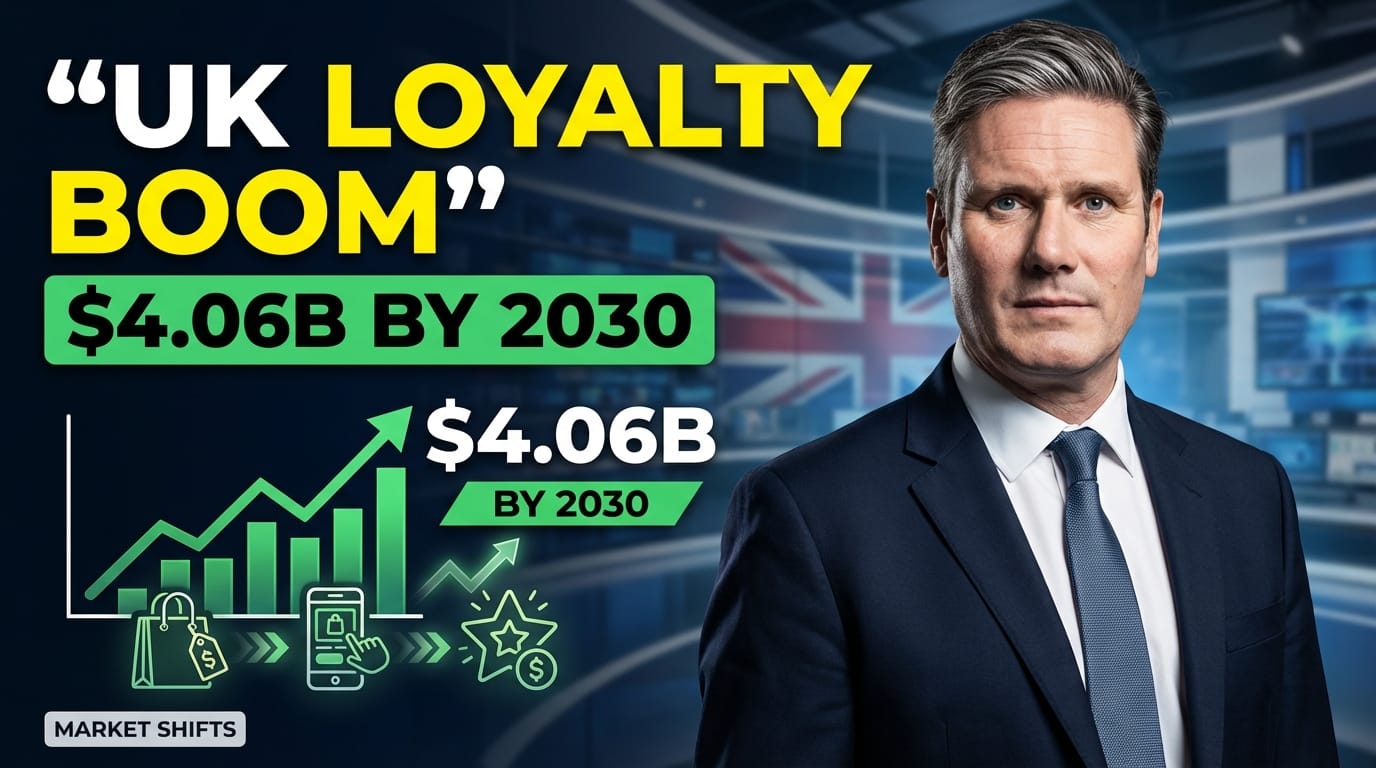
The United Kingdom loyalty market is forecast to continue its strong expansion over the rest of the decade, growing from an estimated value of $2.33 billion in 2025 to $4.06 billion by 2030. According to a newly released databook added to ResearchAndMarkets.com, competition in the sector is no longer centred on launching new loyalty schemes, but on optimising and embedding existing programs more deeply into everyday consumer activity.
The report highlights a structurally mature market where high participation rates and strong incumbents have reshaped how brands compete. Rather than disruption, the focus has shifted to refinement, integration, and compliance.
Market
The loyalty market in the United Kingdom is expected to grow by 13.5 percent year on year to reach $2.64 billion in 2026. Between 2021 and 2025, the sector recorded a compound annual growth rate of 15.5 percent, reflecting strong post-pandemic engagement across retail, travel, and financial services.
From 2026 to 2030, growth is forecast to moderate slightly to an annual rate of 11.3 percent, driven by optimisation of existing schemes, increased digital adoption, and deeper integration of loyalty into pricing, checkout, and customer engagement processes.
Competition
The report characterises the UK loyalty market as highly penetrated, with competition driven by execution quality rather than new program launches. Large brands are refining reward mechanics, benefit structures, and digital journeys to maintain relevance without disrupting established customer bases.
Competitive advantage increasingly lies in how loyalty is embedded operationally, rather than in headline rewards. This includes personalised pricing, member-only offers at checkout, and tighter integration with customer communications.
Scale
Major players continue to dominate the market. In grocery and retail, brands such as Tesco, Sainsbury’s, and Marks and Spencer use loyalty as a core commercial lever closely tied to promotions and pricing. In travel, British Airways remains a benchmark through its Avios programme.
These scale players benefit from high-frequency usage, deep data sets, and habitual engagement, making displacement by new entrants unlikely. Innovation within these programmes is typically incremental, reflecting their size and established member expectations.
Trends
The report identifies several trends shaping the future of loyalty in the UK. Loyalty is moving away from a simple points-based model toward app-led, personalised, and partnership-driven experiences embedded into daily consumer behaviour.
Retailers are increasingly focusing on targeted value in essential categories. For example, grocery loyalty schemes are being used to influence basket choices and shopping frequency through personalised missions and category-specific rewards rather than blanket discounts.
Digital
Mobile apps are becoming the primary operating system for loyalty membership. App-led programmes enable frictionless identification at checkout, stronger first-party data capture, and more direct communication with members.
Mid-sized retailers and co-operative groups are modernising legacy card-based systems, raising expectations around usability, real-time offers, and digital identity. This shift is also allowing faster iteration of loyalty mechanics compared with traditional plastic-card programmes.
Services
Loyalty is also expanding beyond retail into financial services. UK banks are increasingly embedding rewards into account propositions to improve retention and reduce churn. Travel rewards and bundled benefits are being used as part of tiered or subscription-based banking products.
This “rewards-as-a-product” approach reflects the UK market’s strong affinity for travel-related loyalty and co-branded ecosystems, while allowing providers to better control reward economics.
Partnerships
Partnerships are becoming central to loyalty strategies, enabling programmes to function as ecosystems rather than single-brand benefits. Cross-sector collaborations allow brands to broaden perceived value without building new capabilities internally.
The report notes growing emphasis on structured partner governance, as programmes seek to balance breadth of benefits with consistency, cost control, and regulatory compliance.
Regulation
Regulatory scrutiny is increasing as loyalty becomes more embedded in pricing and digital purchase journeys. The Digital Markets, Competition and Consumers Act 2024 has heightened expectations around price transparency, member-only offers, and online practices.
As a result, UK programme operators are investing more heavily in governance, clearer disclosure of terms, and compliant presentation of loyalty-linked pricing to protect trust and limit regulatory risk.
The report concludes that the future of loyalty in the UK will be defined less by new schemes and more by how effectively programmes are optimised, personalised, and integrated into core commercial operations. Brands that combine targeted value, digital-first design, controlled partnerships, and regulatory discipline are expected to be best positioned for sustained growth.
FAQs
How big is the UK loyalty market expected to be by 2030?
The market is forecast to reach $4.06 billion by 2030.
What is driving competition in the UK loyalty market?
Competition is focused on optimising existing programs rather than launching new ones.
Which sectors dominate loyalty programs in the UK?
Retail, travel, and financial services dominate the market.
Why are loyalty apps becoming more important?
They enable personalised offers, data capture, and faster programme updates.