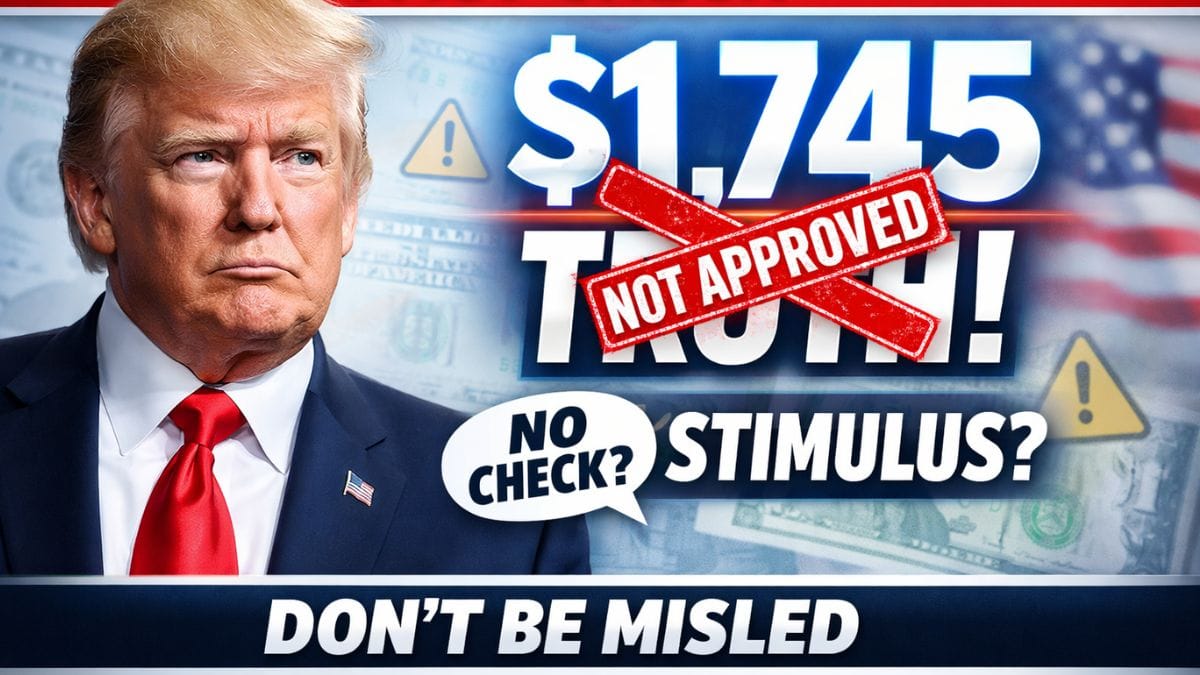
Recent online discussions have widely circulated claims that Americans may receive a $1,745 stimulus payment. The figure has been presented in many posts as a confirmed or upcoming government benefit. However, a closer examination shows that this interpretation is inaccurate. The number is based on economic analysis, not an approved payout program.
Knowing where this figure comes from and what it actually represents is essential to avoid confusion. The discussion reflects broader policy ideas, but no direct payments have been authorized.
Background
The $1,745 figure originates from a congressional analysis of tariffs implemented between February 2025 and January 2026. During this period, tariffs contributed more than $231 billion in additional costs to the U.S. economy.
When averaged across households, this results in an estimated $1,745 per household. Importantly, this amount reflects increased costs borne by consumers, not funds allocated for distribution.
Tariffs typically raise the cost of imported goods. Businesses often pass these higher costs along through supply chains, which leads to higher prices for consumers. In effect, households have already absorbed these costs through everyday spending.
Context
The number gained attention alongside discussions of a proposed “tariff dividend.” This concept suggests that revenue generated from tariffs could be redistributed to households in the form of direct payments.
While the idea has been publicly mentioned, it remains a proposal without legislative backing. There is currently no formal policy, program structure, or administrative plan associated with such payments.
It is important to distinguish between a policy proposal and enacted legislation. At present, the tariff dividend remains a theoretical concept rather than an operational program.
Clarification
Claims that the $1,745 amount represents a stimulus check are not supported by official information. No federal agency has announced a payment program tied to this figure.
The following table outlines the difference between common claims and verified facts:
| Claim | Verified Information |
|---|---|
| $1,745 is a stimulus payment | It represents estimated household costs |
| Payments are approved | No approval has been granted |
| Funds are available to claim | No system exists for distribution |
| Online sign-up links are valid | Such links may be misleading |
Accurate interpretation of the data helps prevent misunderstanding and reduces exposure to misinformation.
Proposal
The broader discussion includes suggestions of larger payments, potentially around $2,000 per individual. These proposals have included ideas such as limiting eligibility based on income and allocating remaining funds toward national debt reduction.
However, no formal framework has been established. There are no defined eligibility criteria, timelines, or funding mechanisms currently in place.
Without congressional approval and administrative planning, such proposals cannot move forward into implementation.
Constraints
Several factors complicate the feasibility of any tariff-based payment program.
One key issue is legal uncertainty. A February 2026 ruling by the Supreme Court of the United States questioned the authority used to impose certain tariffs. This decision placed more than $175 billion in tariff-related revenue at risk.
Additionally, the scale of potential payments presents a challenge. Distributing $2,000 to a large portion of the population could cost approximately $680 billion. This would require substantial funding and careful fiscal planning.
Administrative logistics also remain unresolved. Any nationwide payment system would require coordination across agencies, verification processes, and distribution infrastructure.
Effects
While discussions focus on potential payments, the economic impact of tariffs has already occurred. Increased import costs have influenced pricing across various sectors.
These effects include:
- Higher retail prices for goods
- Increased costs for manufacturers
- Broader price adjustments throughout supply chains
As a result, the estimated $1,745 reflects financial pressure experienced by households rather than a future benefit.
Misinformation
The spread of the $1,745 stimulus claim highlights how quickly economic data can be misinterpreted. A factual figure, when presented without context, can lead to incorrect conclusions.
Online platforms often amplify simplified or incomplete narratives. In this case, the distinction between cost and compensation has not always been clearly communicated.
Consumers should rely on verified government announcements and established sources when evaluating such claims. Legitimate payment programs are typically accompanied by official statements, clear eligibility guidelines, and structured distribution plans.
Outlook
Future policy developments could revisit the idea of returning tariff revenue to households. However, several steps would be required before any payments could be considered:
- Legislative approval
- Legal clarity regarding tariff authority
- Reliable funding sources
- Established administrative systems
Until these conditions are met, no tariff-based stimulus payments are in effect.
The $1,745 figure remains an estimate of past economic impact rather than an indication of future financial support. Careful attention to verified information can help individuals better knowing ongoing policy discussions and avoid confusion.
FAQs
Is the $1,745 stimulus confirmed?
No, it is not an approved payment.
What does $1,745 represent?
It reflects avg. tariff costs per household.
Is there a payment program now?
No program has been announced.
Are online claims reliable?
Many are misleading or inaccurate.